

 By Dylan Lightfoot
It’s not news that construction projects are popping up around Belknap Campus like tract housing in suburbia. The addition to Ekstrom Library is now in the framing stage, and the former Algood plant on Floyd Street has been razed to make way for a new athletics field. Plans to expand Cardinal Stadium are also now on the drawing board.
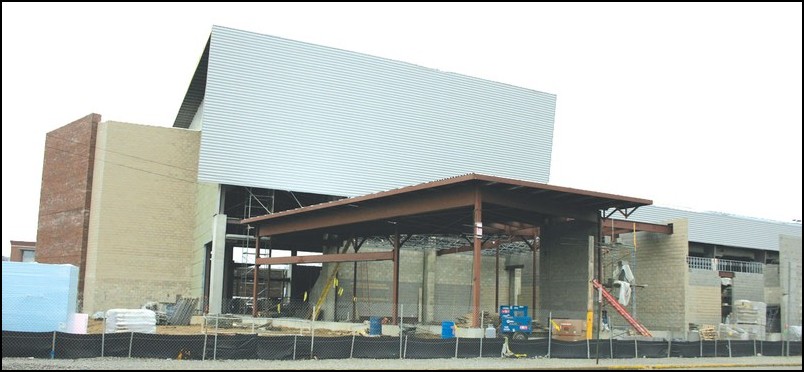
But the campus won’t look like the southern Indiana stretch of I-65 for much longer. The two most visible changes to the University of Louisville landscape — the Belknap Research Building and the Ralph Wright Natatorium — are scheduled for completion this summer. These facilities quite literally stand as concrete representations of U of L’s dual nature as a half-athletics, half-academics institution. They also embody the if-we-build-it-they-will-come philosophy that drives campus planning and construction at U of L.
According to Project Coordinator Bill Brasch, the U of L natatorium is the final phase of Cardinal Park, a series of development projects intended to “dramatically improve the quality of the athletic facilities at U of L.”
Formerly a large parking area between the main campus and the freeway, Cardinal Park “has given the university a nice front door,” Brasch said. “We now look like a campus that is not just a commuter campus anymore.”
“The Nat,” which will be completed mid-July of this year, will allow U of L and Louisville in general to attract more prestigious events, Brasch said.
The facility was designed by architectural firm Browning, Day, Mulling and Dierdorf, which has designed swimming venues for other universities. It will house a 993,000-gallon pool with moveable bulkheads allowing it to be divided for various types of swimming events with seating for up to 800 spectators. Springboards of 1 and 3 meters in height will be installed, as well as concrete platforms of 5, 7.5 and 10 meters to allow the full range of diving competition.
After some “value engineering,” Brasch said, the final bill for the natatorium will total $10.8 million. Funding was furnished by athletics fees levied on the student body. The pool will be open for use by the student community.
Brasch said that the natatorium was meant to fit in with the idea that “the athletics facilities should compliment and dovetail with academic facilities,” adding that “Better infrastructure equals better students.”
The Belknap Research Building, to be completed on schedule in June, will also be a prime infrastructure for bringing in better students and increased funding to the university. The $42-million structure will provide U of L with 117,000 square feet in which to conduct “interdisciplinary research in cutting-edge fields such as nanotechnology, electro-optics, bioengineering and microfabrication,” according to the U of L Web site.
Stephen Cotton of the Department of Planning, Design and Construction said each of building’s three floors will be dedicated to certain types of research. The third floor will be generally devoted to Arts and Sciences research in Physics, Chemistry and Biology, while the second floor will contain “dry labs” for Speed School engineering work.
The bottom floor will house a large vibration-sensitive clean room for micro- and nano-scale fabrication. Crucial to the operation of the clean room, the size and number of airborne particles per liter in the clean room will be monitored and maintained by a specialized air quality control system that will occupy the entire fourth floor.
Work made possible by the clean room will include development of parts for artificial hearts in association with U of L’s Health Sciences Center, as well as valuable services to industry that will enable the facility to generate some of its own funding.
The clean room still has multiple stages before completion, and will not be up and running until June 2006.
“Research [at the Belknap Research Building] will eventually create jobs in our neighborhood” and give scientists “a place to work where they are only limited by their imagination,” Cotton said.





