 By Tracy F. Harris
Best Buy is a heaven of electronics, including cheap — very cheap — computers. Rows of big black cases face shiny metallic Alienware equipment. Oh, but what’s that over there?
Yeah, that little white box. Hooked up to the thin, aluminum-edged monitor. That doesn’t belong here. In fact, it looks like a Mac. Wait! It IS a Mac!
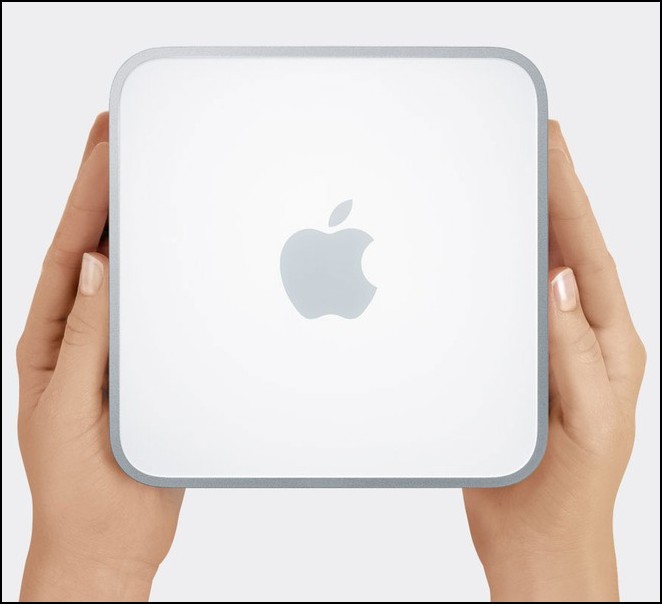
That’s right. Apple is infiltrating the electronic superstore. Its new Mac Mini, the Mac for the masses, will be on sale in Best Buy, the company announced on April 5.
Granted, the B.B. has sold Apple’s iPod for a while — and I’m sure the company has sold plenty to eager PC users. However, let me take a moment to preach my theory. The iPod: obviously the most popular Macintosh product in the history of the company. IPods have been snatched up mainly by teens and college students, who primarily use Windows machines and have no idea how a Mac works or where to get one.
IPod users love the pod. They name them. Carry them everywhere. Obsessively buy accessories. They begin to think about buying a Mac. “But they’re so expensive!” they realize.
No more. Enter the Mac Mini. Selling for $499 or $599, depending on features, it’s the cheapest Mac ever produced. It also comes without keyboard, mouse or monitor — the theory is, you already own a PC. Hook those components up to your new Mac. Yes, they’ll work, even though they’re not nearly as pretty as a Cinema display and Apple Pro keyboard.
Now, Steve Jobs thinks, I have produced an affordable Mac that iPod users will love. At 6.5 inches by 6.5 inches by 2 inches thick, how could anyone not love it? But how to get it to them …
Enter Best Buy. The marketing people at Apple are geniuses. After dominating the MP3 player market, the company’s market share will now slowly increase … and one day, Steve Jobs will be the world’s best-known dork, not Bill Gates. One day. And on that day, Mac users will rejoice and say, “I told you so!”
Back to the point. Since iPods became ridiculously popular, analysts have looked for a “halo effect,” meaning that increased iPod sales would increase sales of other Mac products.
According to a Reuter’s story, Jobs thinks the effect “is real and the company is definitely seeing evidence of that.” Mac Mini sales will, Apple hopes, support those feelings.
Of course, there has to be a downside. Apple computers are sold at relatively few chain locations — CompUSA pretty much corners that market. Some Best Buys briefly offered other Macs as part of a pilot program, but that has since been discontinued.
Instead, Macs are bought and serviced at small shops, usually locally owned. Like the one here in Louisville.
MacTown, located on Bardstown Road in the Highlands, is just an incredible place to visit. The shop is all windows, and even driving down the street, the gleaming white and aluminum Macs beckon. Inside the store, old clamshell iBooks come in for service and teenagers buy accessories for their iPods. The staff is amazingly friendly and helpful; nearly every Mac toy a person could need is in stock.
So, selling the Mac Mini and iPods out of Best Buy will likely draw some business away from MacTown — even though potential clients unused to the Mac world would most benefit from the service and knowledge of the MacTown staff.
My bottom line? I don’t want those PC users in my Mac store anyway, so they can buy their iPods wherever they want. As for the Mini, well, we’ll see.
The low-end version, for $499, contains a 1.2GHz G4 processor, 256MB DDR-RAM, an ATI Radeon 9200 graphics card, FireWire, USB, DVI video connector, 10/100baseT Ethernet, modem, DVD-reader/CD-burner and a 40GB hard drive. The high-end version for $100 more increases the processor to a 1.42GHz and a 60GB hard drive.
Tracy F. Harris is a sophomore majoring in Communication and Assistant Managing Editor for The Cardinal. E-mail her at: tharris@louisvillecardinal.com