

 By Adam Collins
This week’s continuation and final segment of “Inside the System” explores possible solutions and where Kentucky’s elected officials stand on Social Security reform.
POSSIBLE SOLUTIONS & EFFECTS
In order to deal with the looming questions of the social security program’s solvency a number of solutions have been proposed and discussed.
Raising the percent of wages social security collects from payroll taxes would provide greater amounts of revenue and ease concerns over social security’s future. This solution is unlikely, however, because it is not politically palatable to raise taxes on working Americans.
Another option would be to raise other taxes and simply earmark the revenue collected to the social security program. This solution would also be unlikely, however, for many of the same reasons.
Cutting the amount of benefits each retiree is eligible to collect is another unpopular answer to the questions facing social security. Seniors and many senior citizen advocacy groups are firmly against this option as they contend that a person surviving on social security alone is already living just slightly above the poverty line.
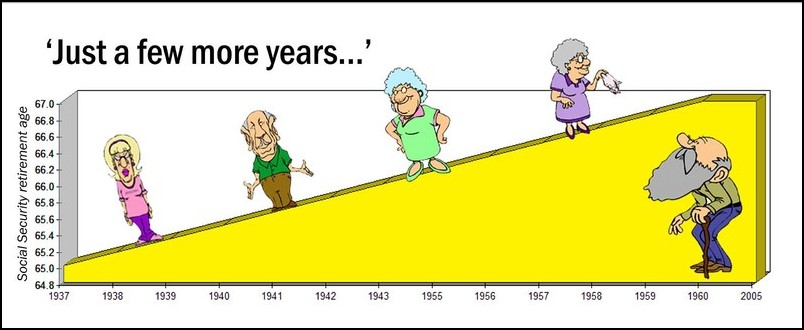
Raising the retirement age is also a possible solution, however, it is also quite unpopular. Given that the program has already begun gradually raising the retirement age to 67 by the year 2027 it does not seem realistic that Congress would agree to increasing age of eligibility to receive benefits.
The proposal that has been given the most attention in recent years, and especially in the past few months, is President Bush’s proposal to create voluntary personal retirement accounts in the social security program. Workers would have the opportunity to set up a personal retirement account in which a portion of the money they pay into social security would be invested, thus growing in worth over an elongated period.
The Bush administration contends that any cuts would be offset by the growth in a worker’s investments over a lifetime. The plan would also establish a minimum benefit payable, which is designed to keep retirees above the poverty line.
In order to safeguard seniors who are near retirement and those who have already reached retirement from sudden market shifts or downturns in the economy, the plan would be grandfathered in, and thus unavailable to anyone age 55 and above. As workers who participate in the program near retirement their personal retirement accounts would also be safeguarded from similar situations by the federal government.
Opponents of the plan note that while the program is voluntary, the benefit cuts, which could reach as high as 46 percent, would apply to all seniors, not just those who had chosen to participate in the program. They also claim that the panel President Bush put in place to study the situation, the President’s Commission on Social Security, was packed with people who favored some type of privatization plan and were more likely to support Bush’s reform proposals.
WHERE KENTUCKY’S ELECTED OFFICIALS STAND ON THE ISSUE
Since President Bush’s State of the Union address last month the spotlight has shined brightly on his proposed social security reform.
Democrats in Congress have made it clear that while they may be willing to listen to any proposal, they do not believe that privatizing social security is a reliable means for maintaining the program’s solvency.
“The Democratic leadership is trying to … get all the Democrats inside the tent,” said Sen. Mitch McConnell (R-Ky.) in an interview with the Associated Press on Feb. 4. “But I think it’s simply unsustainable to argue that nothing needs to be done.”
At the same time most Republicans in Congress have adopted the position of President Bush and are looking toward changes in the program.
“On Social Security, the president hit the nail on the head when he said that we must act now to fix a broken system,” said Sen. Jim Bunning (R-Ky.).
“In 13 years, the program goes into the red, and we can’t afford to keep our heads buried in the sand. The sooner we act, the better,” Bunning said.
“Social Security is able to sustain today’s retirees and near retirees, and for them, nothing will change,” said Representative Anne Northup (R-Ky.-03).
“But for younger workers, the system needs to be restructured to ensure that they can rely on retirement savings just like today’s retirees. I support personal retirement accounts, which will increase savings and keep Social Security from going bankrupt,” she said.
There have been some questions, however, and actual passage of the president’s proposals may depend on the discussion that is to take place over the coming weeks and months.
“Social Security faces a serious dilemma. I’m prepared to hear the president’s proposals and study the work that comes out of committee,” said Sen. Dick Lugar (R-Ind.).





