 By Donnie Niehaus
After a dismal 2003 men’s cross-country season, theCardinals were hoping for some drastic changes by the 2004season.
Insert a new coaching staff and freshman Wesley Korir on theroster.
Pretty drastic measures, but so far, they’ve paid off.
Coaching legend Ron Mann took over the cross country program forthe 2004 season, bringing in many of his former assistants. Twomeets into the season, the Cardinals have brought home twofirst-place team finishes. Louisville finished first out of fourteams at the Woodford Trials, hosted by the University of Kentucky,and first out of nine teams in the Commodore Classic, hosted byVanderbilt University.
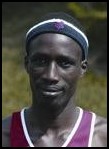
Louisville freshman Wesley Korir won both of the meets.
Hailing from Eldoret, Kenya, Korir comes to the Cardinals viaMurray State University. Similar to that of many Kenyan runners,Korir’s path to the United States is an interesting one.Living in Kenya, where the use of cars is limited, Korir was forcedto walk or run wherever he went. Korir eventually developed thetalent that so many great Kenyan runners possess.
Korir first realized he had a future in the sport in grade school.”I represented my primary school in many competitions and wonmany of the events. That’s when I realized I couldrun.”
The coaching staff in Kenya was limited for Korir. He was forced totrain himself, and with the encouragement of Hilary Cenoge, hebecame a standout runner. After a successful high school career,Korir’s talent was recognized by former Olympic gold medalistand holder of the 800M world record Paul Ereng.
Ereng, coach of the Kenyan IOC team, mentored and coached Korir onthe Kenyan National Team and helped develop his talent. Ereng, aformer American college standout, was extremely influential inKorir’s decision to run at an American college.
“After high school, you either run or go to college, notboth. I wanted to study and run – that’s why I came toAmerica,” Korir said.
Korir chose to attend Murray State because Ereng was friends withMSU’s coach, Norbert Elliot, and they were offering a fullscholarship. However, MSU was forced to cut scholarships and leftKorir searching for another school after one year at theuniversity.
Upon hearing of Korir’s transfer status, many schools werelining up to enroll the talented Kenyan. After considering suchpowerhouses as Butler, Georgia, Southern Illinois University andMiddle Tennessee State, Korir decided that Louisville was his bestchance to succeed in both running and academics.
“I was looking for a good team, a good coach to push me andgood academics. U of L offered all of these and more. My coach atMurray is friends with Coach [Mann] and he encouraged me to comehere,” Korir said.
Mann’s coaching history didn’t hurt Korir’sdecision either.
“Coach [Mann] is an excellent coach and that is evidenced byhis previous team’s top three finishes atnationals.”
To prepare for his first year on the major college level, Korirperformed a rigorous off-season workout that included running over100 miles a week. This has prepared Korir for running in practiceand especially at the races.
“Running 100 miles a week in the summer has got me in greatcondition and makes the meets easier,” he explained.
Korir’s running pace in practice has forced the whole team towork harder. Sophomore Chris Davis enjoys running with Korir:”At practice, he makes others run faster because he is goingso fast. We are trying to catch up with him and that makes us allbetter. He is a huge asset to this team.”
Korir’s off-season workouts have paid off. Entering his firstmeets as a Cardinal, Korir is undefeated and has been able to breakand set three meet records. He currently holds the SouthernIllinois University meet record, the Vanderbilt meet record with atime of 24:50.77, and the Kentucky meet record.
Korir’s performance has impressed his teammates greatly.Davis is always impressed when Korir runs: “He is an amazingrunner; no one has even been close to this guy. Wes has beenwinning each meet with ease.”
Although Korir’s running takes up much of his time, he neverforgets the books. A pre-med major, studying occupies most of histime.
“I consider myself a student-athlete, which means myacademics come first. I spend most of my time in studying. I haveset aside four hours a day for running, and the other eight hoursare for the books.”
Korir has set some lofty goals for himself after graduating fromcollege. “My goals for the rest of my running career are togo back to Kenya and do intensive training for the next Olympics.My goal is to make the Olympics in the next four years.”
With his work ethic and outstanding running ability, Korir is sureto achieve any goal he wants.