 By Stephanie Smith
Confederate soldier joins the Union
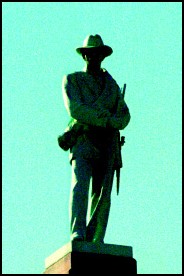
Thirty-one years before Belknap Campus was built, the Women’s Confederate Monument Association erected the statue of a Confederate Soldier between Second and Third Streets. During the dedication in 1895, it was assigned as a “Tribute to the Rank and File of the Armies of the South” and “To Our Confederate Dead, 1861-1865.” While the soldier does not stand on University of Louisville property, the one-sided view of the Civil War disturbs many members of the campus who believe in diversity; the ensuing result of this debate will be the January 20, 2002, dedication of Freedom Park.
The proposal to form Freedom Park on the triangular land occupied by the soldier and the Playhouse was approved at the November 25 Board of Trustees meeting.
President James Ramsey first asked Pan-African Studies department chair Blaine Hudson and Larry Owsley, vice president for finance and administration, what could be done to address the controversy surrounding the monument. The idea for Freedom Park was proposed to be included with the statue rather than removing it, allowing people on both sides of the issue to showcase their heritage.
Owsley said, “The proposal is an attempt to put the monument in a more complete history of the era.”
Dr. Karen Chandler of the English department said, “I can understand African American students’ concern and anger about being part of an institution that has such a symbol… Louisville being an ambiguous place between the Union and the Confederates. It might be a site of student activism, marking a place for greater diversity, more than just Southern tradition.”
Many students feel that this does not solve racial tensions on campus, but they believe that it is a step in the right direction. “It’s not just an issue for African Americans; there are non-African Americans who ask, ‘Why is this in the center of Belknap Campus?'” said Owsley.
The building project does not have a timeline, but the park will likely be developed in stages. The dedication ceremony will fall on the federal holiday honoring Dr. Martin Luther King Jr.
The park will have many elements and features showcasing an interpretive treatment within the context of slavery and the Civil War in Louisville. First, it will provide some general contextual treatment of the Civil War through events, strategies and other points of historical interest, including in-depth looks at such historical figures as Cassius Clay and Harriet Beecher Stowe. Second, it will focus primarily on local events and heroes, including the Underground Railroad, Washington Spradling, James Cunningham, and others.
The new park will also provide a prominent location for a “Struggle for Freedom” statue or plaza and designate areas for future exhibits and statues. A Civil War battlefield memorial using historic tree plantings will also be created. The Playhouse will be used to depict and highlight the struggle using visual arts, performing arts, lectures and other ways to enhance public discussion and thoughtful examination. University plans also include developing a Web site dedicated to the park.
President Ramsey has also informed the trustees that the university has decided that Confederate Place, more frequently known as Greek Row, will be renamed “Unity Place.” The change will be effective January 1, 2003.
Discussions related to planning for Community Park, which might include a residence hall and refurbished housing for Greek organizations, inspired the name change. Students and other campus members decided on the new name.
“If a significant number of people are offended, I have no problem with making a simple name change to make everyone more comfortable,” said Pi Beta Phi member Emily Pierce.
However, not all students feel that the change is necessary. “The people who have Confederate ancestry shouldn’t have their heritage suppressed because the university wants to submit to notions of ‘political correctness.’ It has been argued that Confederate Place is just a name, so a change to it shouldn’t matter,” said Jason Feathers, a senior English major.
In a written proposal, Dr. Hudson said, “As the Brookings Institution Report (Beyond Merger, 2002) indicated, Louisville remains a community divided along class and racial lines. By making this both a University-wide and a community-wide project, the University of Louisville can take the lead in healing those divisions.”