 By Matt Morris
Lecture series continues campus discussion of U.S. morality in world affairs
The second night of the lecture series coordinated by U of L’s History Department and the Interfaith Center took place Thursday in Ekstrom Auditorium, with the intent of addressing questions concerning national morality in national and international affairs by exploring standards from civic religions, domestic religions, world religions, and theories from philosophers, religious leaders, and humanists. Over fifty people attended to participate in the panel.
Dr. Thomas Mackey, chairman of the U of L History Department, opened the lecture by encouraging the audience to take an active role in the series, as it is intended to come across as informative, challenging, and thought-provoking. Dr. Mark Blum echoed Mackey with his encouragement of questioning and debate, and offered the Internet address http://www.louisville.edu/a-s/history/terror/ for those interested in continuing discussion even after the night ended. Mackey welcomed people to continue to develop new questions and comments to challenge the speakers.
Professor Emeritus James Hart of Indiana University was the first speaker of the evening. Dr. Hart’s discussion was in the field of religious studies. His speech, entitled “The Culture of Death and Collateral Damage,” addressed the nature of foreign policy, which he referred to as “the mega machine.” He contested that the “mega machine” was not influenced by religion or morality. However, the waving of the flag in images across the nation and the phrase “under God” in the Pledge of Allegiance serve simply as propaganda, and, under scrutiny, religion and morality would not hold up. Dr. Hart also pointed out that democracy in the U.S. is local, at best, and public TV and radio must be altered to resemble Canada’s public broadcasting system, where people may honestly relay their thoughts and ideas without being interrupted every five minutes by a commercial that breaks the audience’s attention.
Dr. Avery Kolers of the Philosophy Department spoke regarding “Broadening the Criteria of Just War.” He discussed components of a theory that sets guidelines for justification of war. Kolers earned laughs from the crowd with his thoughts on some of the proceedings of the U.S. government. He said, “Democracy is about electing good people and not trusting them too much.” Quoting from the Washington Post, he read a statement from a military official addressing the terrorist threat, which read: “This is the most information-intensive war you can imagine; we’re going to lie about things.” Kolers also gave his view on the 9/11 bombings and his thoughts on Osama Bin Laden. Kolers believes that the U.S. must take some action terrorist campaigns, but said that if he were acting as president, he would view Bin Laden as a criminal that must be brought to justice. The point was also made that going after Bin Laden does not mean, however, “bombing people that aren’t him.”
Dr. Blum offered time between presentations for speakers to take questions from the audience as well as general comments. The questions were wide-ranging, and comments varied from conservative to liberal and to outright challenging as the night continued. One comment was made concerning those responsible for the 9/11 bombings, claiming that Osama Bin Laden was not responsible for the attacks and the idea of a conspiracy theory implicated.
Some U of L students who took part in the lecture series felt enriched intellectually by the event. Eric Kennedy, a sophomore majoring in political science, said, “I consider myself a relatively conservative person. Hearing some of the liberal arguments was interesting, and I respect them.” Beth Wesley, a sophomore history major, commented, “Forums like this help us to talk more about the ideas that come up in class, but we don’t get the opportunity to spend much time on.”
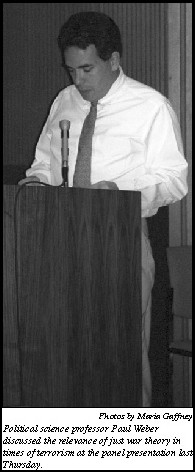
The lecture also held religious tone, provided by Mark Feather of the Interfaith Center, who spoke on “Scriptural Reflections on Terrorism and War.” Professor Paul Weber of the Political Science Department touched on “Just War Theory,” and addressed some military advancements, such as precision weaponry, which have furthered the justification of war. The next panel will take place on Thursday, November 7, at 6:30 PM. For more information on the lecture series, contact Mark Blum at 852-6817.