 By Stephen George
Protesters contrast Bush policies
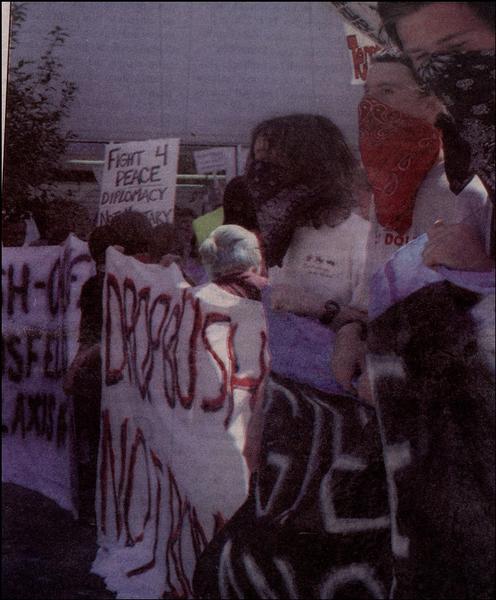
President George W. Bush’s visit to Louisville last week sparked a nonviolent protest by local community activists lamenting many of his administration’s policies, most notably the ongoing debate over a war with Iraq.
The protest took place about 20 yards from the Seelbach Hotel, where Bush spoke at a $1,000-per-plate fundraiser for 3rd District Congressional Representative Anne Northup. Horse-mounted Louisville Police officers, county police, SWAT team and federal officials lined the wooden barricades on Fourth Street. Protesters and police alike remained peaceful throughout, despite their close proximity and relatively volatile history with each other.
Gatherers, which numbered around 150, chanted phrases such as “No blood for oil,” “Ho ho ho, Bush has got to go,” and “1-2-3-4 No more Gulf War 5-6-7-8, No more police state!” throughout the protest, which began shortly before noon and lasted well into the afternoon. Many of the protesters also carried signs, some of which were straightforward-“Bush is a terrorist,” “No war on Iraq,” “Students won’t kill for oil: U.S. out of the Middle East,” “Don’t kill for us!”-while others were a bit more sarcastic, yet just as poignant-“Jail to the Thief,” “Impeach Bush and Ashcroft before they jail us all,” “Drop Bush not bombs,” and “Let’s be honest! How can large companies make money on this war?”
There were several recognized organizations present on Fourth Street, among them the city’s Ad Hoc Committee Against War with Iraq, the Fairness Organization, and the U of L Peace and Justice Committee, a collective comprised of faculty members and graduate students.
Associate Professor of Physics Dr. John Morrison is one of the leaders of the committee. “We’re opposed to arbitrary behavior on the part of our government,” Morrison said. “We’d like countries to work in unison rather than the U.S. to write some rule up on the blackboard and punish a country that doesn’t follow it.”
Morrison and Assistant Professor of Philosophy Avery Kolers, who is also one of the leaders of the faculty committee, said their group has been mostly concerned with the increasingly tense situation between Palestine and Israel since it began in the early 1990s, but that the current dilemma over a war in Iraq has blossomed a new interest. In the case of Afghanistan, Morrison explained, “There was a clear connection to something that happened in the United States. But in the present case, the reasons that are given are so tenuous. The whole idea of preemptive is that you attack them before they’ve done anything, so it’s not something that causes a lot of confidence if you believe in fair behavior.
“We are against this war with Iraq,” he continued. “There hasn’t been any real consistent explanation for why we’re going to do it.”
Kolers agreed, though he stopped short of claiming a full anti-war sentiment for the committee. “I would characterize our group mostly as a group of people who tend to be a lot more skeptical about the use of force overseas,” he said.
Many U of L students were also there protesting the Bush administration’s policies. Sophomore anthropology major Eileen Hagerman differentiated between the administration’s stand on terrorism and its eagerness to attack Iraq. “I don’t support the Bush administration’s plans to go to war with Iraq,” she said. “The Bush family has made its money from oil. War wouldn’t be about terrorism; it would be about oil.”
Hagerman said she joined the protest to help enact some public discourse about what some would term hasty decision-making by the administration. “I want to encourage debate over the issue,” she explained. “I want to cause Bush to rethink his plans.”
It is unlikely that the President even saw the protesters, though he was almost certainly informed of their presence. “I don’t think anyone has any big illusions about changing Bush’s mind,” said Chris Ehrick, a Latin American history professor at U of L. “I think what’s important is that the position has been that the American people support the war (in Iraq) and we want to make it publicly clear that there are people who don’t support it… to show Bush that there is resistance to his policy. There are people who disagree, and it’s okay to disagree.”
“We need to show Bush that not everyone is in favor of (this war),” said U of L sophomore Erika Lundbom. “No one is thinking about the repercussions of attacking (Iraq). Killing their leaders is not going to help anything.”
Janene Shakir, a local educator and a Muslim, was at the protest passing around a petition to urge the administration to change their policy toward Iraq and the Middle East in general. Shakir, the mother of four children (one is a graduate of U of L and is currently in the military), sees Bush’s Iraq initiatives as a smokescreen for the recent influx of white-collar crime. “I feel like it’s all a cover-up for all this higher-up political and economic crime going on,” she said. Shakir went on to discuss the detrimental effects of the U.S. sanctions that have been on Iraq since the Gulf War ended in 1991. “I don’t like the Bush administration’s policy all the way around,” she explained. “Bomb them, starve them, bomb them again. I work, live and fight for peace.”
According to Kolers, the Faculty Committee for Peace and Justice, as it was formerly known, began in 1990 as a listserv email discussion group until around the time of Sept. 11. It has been more active in the last 11 months as a coalescing group of individuals more than an email group. And although there are not currently any undergraduate students in the committee, it is open to everyone in the university community and welcomes undergraduates to join. “I hope that in the long run we may have more active students involved,” Morrison said. “My experience with students is that many of them are concerned about the world, the environment, about what direction our own country takes, and they’d be very willing to participate in a discussion of these issues. Our organization does not say you have to think this way or that way.”
According to Morrison, there will be a table in front of the SAC on a regular basis in the coming weeks to encourage more student involvement, especially on the undergraduate level.
Kolers will be speaking at the October 3 panel on US Justice and Morality in Times of Crisis. The panel, which was initiated in light of the one-year anniversary of September 11 as a collaborative effort between the History department and the Interfaith Center, is a monthly event held in the Ekstrom Auditorium on the first Thursday of every month at 6:30pm.