By Josie Simpson
On April 18, the Grawemeyer Awards ceremony took place on the University of Louisville’s campus, bringing together scholars, artists, researchers and the broader Louisville community to celebrate the groundbreaking ideas that shape the world.
Originally established by Charles Grawemeyer, a U of L alumnus and philanthropist, the university has hosted the Grawemeyer Awards since 1984. The awards have been a way to recognize ideas accessible to the general public, rather than private knowledge held by certain academics.
The ceremony honors these ideas annually in education, music composition, psychology, religion and world order, with each recipient awarded a $100,000 prize.
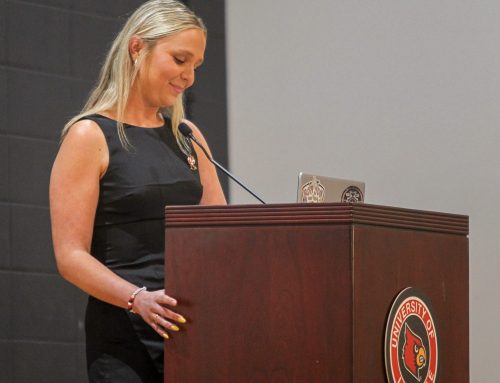
John Ferre, director of the Grawemeyer Awards, began the ceremony with acknowledgments of the broader purpose behind the awards, stating the connection between research and creativity to real outcomes.
Music Composition–Lisa Lim
The first award of the night, music composition, went to Lisa Lim for “A Sutured World,” a piece centered on healing and repair. The composition draws on themes of storytelling, trauma and restoration.
It uses music to explore how people make meaning from damage rather than hide it. Lim, the 38th recipient in the category, spoke about music as “an invitation to listen.” She emphasized the role of the audience in the creation of art.
“One of the humbling things about being a composer is that it’s the listener who completes the circuit of meaning.”
World Order–Joshua Busby
World order, the second award of the night, went to Joshua Busby, who was recognized for his work on climate change, specifically for how to equip countries to handle environmental crises rather than to prevent them.
His research examined why some countries can handle these crises better than others. He found the difference comes down to governance–strong institutions, political inclusion and openness to international assistance can significantly reduce the risk of conflict and humanitarian disaster.
“The findings provide us with some cautious optimism that countries can develop state capacity to prevent climate hazards from leading to the worst effects.”
Psychology–Sir Simon Baron-Cohen
The psychology award went to Sir Simon Baron-Cohen, whose decades of research have reshaped how autism is understood. His work focuses not just on the challenges associated with neurodiversity but also on its strengths.
In his remarks, Baron-Cohen called for more inclusive systems in education and employment, noting that a lack of support services continues to limit opportunities for autistic individuals.
“They don’t often get an opportunity to shine. That’s a loss for our society, it’s a loss for them, it’s also a loss for us, because they have a valuable contribution to make.”
Religion–Candida Moss
In religion, Candida Moss was honored for her book, “God’s Ghostwriters: Enslaved Christians and the Making of the Bible,” which examines the overlooked role of enslaved labor in the production of early Christian texts.
Her research argues that the ones who played a critical role in shaping the Bible–scribes, secretaries and copyists–were enslaved people. However, this information is not widely known. Moss used her acceptance speech to ask audiences to reflect on invisible labor and reconsider how credit has been assigned in both past and present works.
“We live in a particular moment that is fixated on individual accomplishment, on the role of CEOs, of authors like myself, but I represent the labor of so many others. I would like to invite us to create a world where we acknowledge the labor of others.”
Award recipients spent the rest of the week on campus engaging with students and faculty through lectures and discussions.