By Sara Montoya
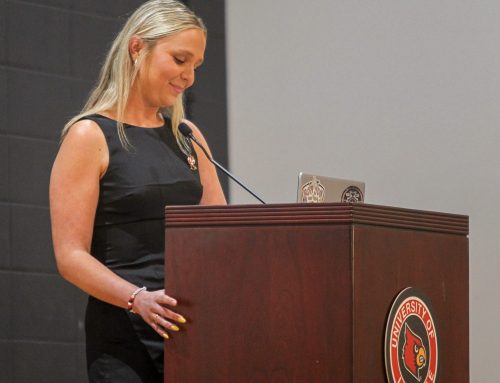
Former U.S. Ambassador Kelly Craft spoke to UofL’s students at the College of Business on Sept. 10. She discussed her experience in national and foreign affairs and discussed diplomacy’s role in today’s political climate.
Here are the takeaways.
Learning through diplomacy
The former ambassador opened by sharing what it truly means to represent the United States abroad. She reminded students that being a diplomat is never about personal views, but about carrying the voice of the nation.
“You are not representing yourself, you are representing the leadership of your country,” she said.
Drawing on her own career, she admitted that she has made mistakes during tense moments at the United Nations but said those failures shaped her as much as her successes.
“Never be afraid to make mistakes; they become the greatest lessons,” she said.
China’s growing role in Africa
She then shifted to one of her central concerns: China’s increasing presence in Africa.
Craft said Chinese infrastructure projects and loans appear beneficial at first, but ultimately leave countries financially dependent.
“These are predatory lending practices,” said Craft.
In contrast, she argued that U.S. involvement should focus on strengthening democratic institutions and education with an emphasis on creating opportunities for women. She highlighted that these investments build resilience rather than dependency and better reflect America’s long-term values.
Israel-Hamas war sparks tense discussion
Craft’s remarks on the war in Gaza prompted some of the most pointed exchanges of the event.
She stated that Israel is not committing genocide under its legal definition, and instead highlighted Hamas’s significant responsibility for civilian suffering.
“Hamas is using civilians as human shields,” she said, referencing the group’s October 7 attacks and its tactics in Gaza.
Several students challenged her position, raising concerns about civilian casualties and the bombing of areas where humanitarian aid is distributed. In response, she acknowledged she had not seen some of the reports described but pledged to look into them further.
She also highlighted the importance of context and education in conversations about international conflicts, noting, “You have to look at all the history and the facts before making any conclusions,” and encouraged students to research carefully and approach such topics with critical thinking.
Energy and Poverty
Craft discussed how access to reliable energy drives economic development.
“You can’t create wealth without energy,” she said, noting that without electricity, schools, hospitals, and businesses cannot function.
While renewables are important, she argued that fossil fuels remain critical in the short term for countries struggling with poverty. She also emphasized that energy must be paired with essential skills and local systems: teaching responsibility, providing practical tools, and empowering communities to turn energy into lasting economic growth.
Photo by Sara Montoya-Obando / The Louisville Cardinal