 By Brett Mcgrath
To Andy Mudd and Dr. Keith Mountain global climate is a key issue of not only this generation, but of future generations as well.
According to Mountain, the Geography/Geosciences department chairman, there is absolutely no room to debate global climate change.
“The media wants to be balanced,” he said, adding that the media is largely responsible for the lack of awareness. It is in this balance that the people of the U.S. are confused and led to believe that there is still, after so many years of consistent research and time-tested science in support of the facts, the notion that global warming is as easily debatable as an abortion.
Mountain said that glacier melting records date back as far as the 1880s when startling rates of rapid change were first surveyed on Mt. Kilimanjaro, and a lot of solid scientific findings have been seen since then. We have “learned more in the last 10 to 15 years about global climate systems than we ever have before,” said Mountain.
Is this climate change a result of what man has done on earth? “Yes,” said Mountain.
“There is a cost to this, it is just a question of who is going to pay it.”
Mountain for most of his life has tried to stay away from the politics of the matter. He now realizes that politics in regards to global climate change are inseparable from the science and even though he is not an activist, much must be done in terms of activism to see that we can correct this problem.
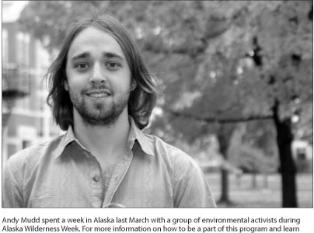
Mudd, a biology major, is well versed in the politics of global climate change and other environmental issues after his trip to Washington D.C. with Alaska Wilderness Week, in March 2007.
Mudd’s activism mostly surrounds issues concerning Alaska. “Alaska for me,” he said, “is the last chance for us as a nation to save something that is actually truly wild and not destroy it as we have done with the other 48 lower states.”
Mudd sees himself as an activist and was originally brought into the environmentalist movement through his love of the outdoors. Mudd’s work with activism involving Alaska deals more with the issues concerning oil-drilling rights, protection and prevention of clear-cut logging in protected forestland.
Mudd is not able to separate global climate change from his agenda of activism. “GCC is real and it’s definitely a worldwide problem,” he said.
Mudd met with congressmen from both parties and learned how lobbying is conducted.
According to Mudd, he received generally three types of reactions afterwards, those who believed in environmental protection, those who listened to him blindly, and those that seemed appreciative that he was talking to them. Though they were probably not swayed past their original personal agendas as legislators.
Stephen Oost, a freshman engineering major said, “I don’t know enough about it to say one way or another.” Oost feels he is definitely in the “don’t know don’t care” category, he does not see that this issue effects him very much.
Mudd and Mountain know firsthand the effects of global climate change on our planet.
“Go out and do something about it. Instead of saying, ‘Somebody should do something about that.’ Be that someone and get out there and make a difference,” said Mudd. “It doesn’t have to be a big difference, a small one will do.”