

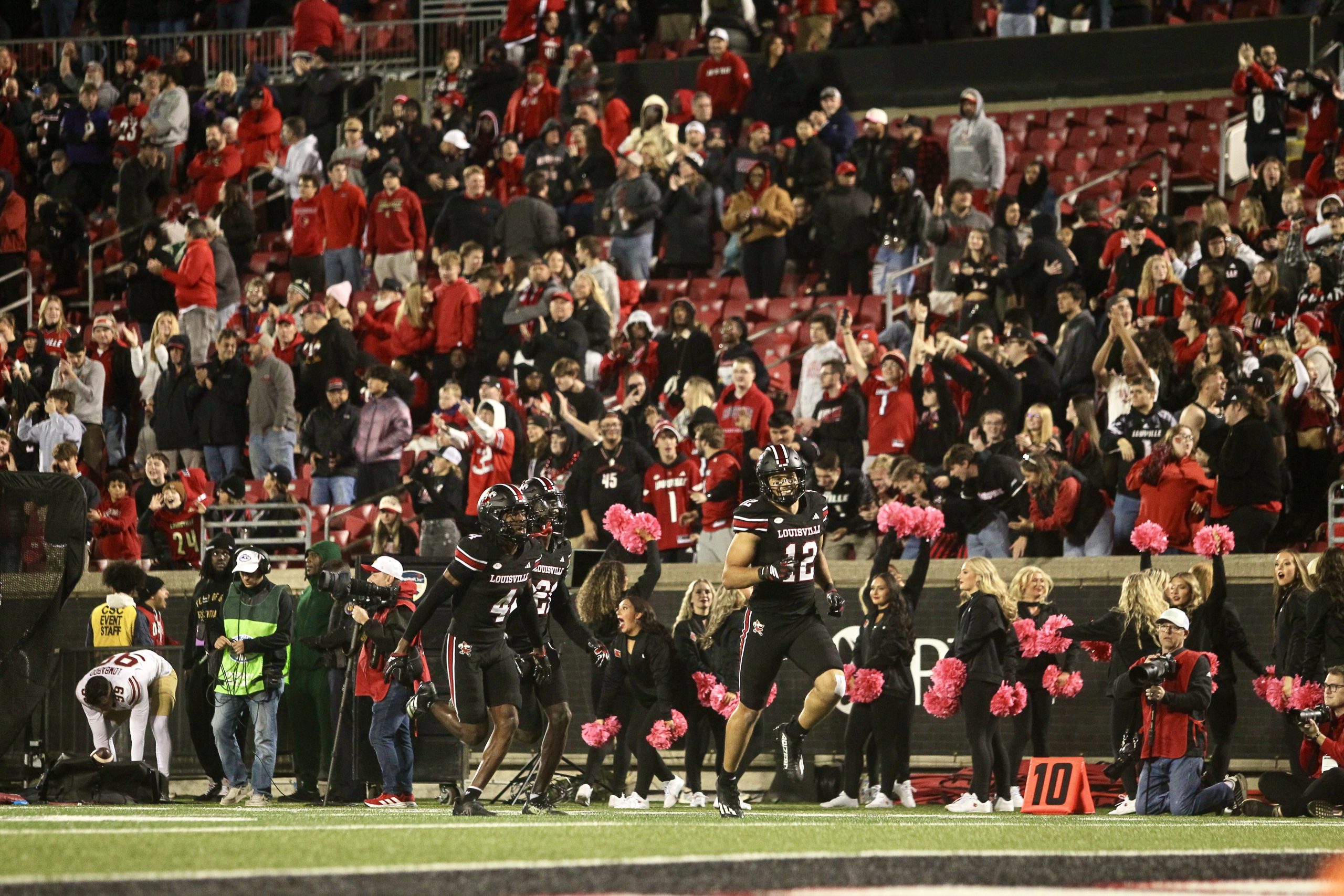
Editor’s Note: Kalib Perry was granted a motion to intervene by the Jefferson Circuit Court on Monday, Sept. 14, and is currently eligible to play.
By Victoria Mastin
Kalib Perry has spent months preparing for another season with Louisville football. What he still does not know, however, is whether he will be allowed to play.
Perry, a fifth-year linebacker for the Cardinals, is one of many college athletes from the high school Class of 2022 caught between the NCAA’s old eligibility rules and its new system. Days before Louisville’s season opener against Ole Miss, Perry said he was still working through the courts to receive clearance to compete.
“I’m still in the process of getting approved through the courts right now,” he said. “That’s been the whole thing, just kind of phone calls.”
For Perry, the uncertainty means continuing to practice with his teammates without knowing whether he will be able to take the field with them. “It definitely is frustrating,” he said. “I feel like I’m getting an opportunity taken away from me.”
Class of 2022
Under the NCAA’s previous system, college athletes generally had four seasons to compete. Exceptions such as redshirts and medical waivers that could give them more time.
The NCAA’s new system gives athletes five years of eligibility within a five-year window. However, the new rule begins with athletes from the high school class of 2023, leaving out those from the previous class.
Anita Moorman, a professor of sport administration at U of L, discussed how that cutoff is currently at the center of a legal fight. “If the new standard is five years, we should get five years, too,” Moorman said, describing the argument from athletes challenging the rule.
The NCAA claimed roster limits, opportunities for incoming athletes and the need to establish a cutoff in defense of the new system. But athletes across the country have challenged their exclusion in court.
Different athletes, different answers
The lawsuits have created a situation in which athletes in nearly identical positions can receive different answers about whether they can play.
John Cross, professor emeritus at U of L’s Brandeis School of Law, said a court decision involving one athlete does not automatically apply to everyone in the same situation. “You can only be bound by a decision if you were a party in the first suit,” Cross said.
That means an athlete protected by a court order may be allowed to play while another athlete in a similar position remains ineligible. Those orders can also be appealed or reversed, causing an athlete’s eligibility to change as the case moves through the courts.
Perry is experiencing that uncertainty in real time. He said he knew getting another season would not be easy, but the process has him feeling like he is “jumping through different hoops” for another chance to play.
Some days, Perry said, he spends three or four hours making phone calls, sending texts and trying to figure out where his case stands. “It feels like it’s consuming,” he said. “At the end of the day, I want it to be done so I can just focus on what I need to focus on.”
Football has become one of the few places where he can get away from the uncertainty surrounding his eligibility.
“When I do have the chance to just practice, I kind of try to make that an escape for me,” Perry said.
A bigger fight with the NCAA
Marc Edelman, a Baruch College law professor who specializes in sports and antitrust law, said the eligibility cases are part of a larger legal fight over how the NCAA regulates college athletes.
“The NCAA’s eligibility rules overall are highly susceptible to antitrust challenges,” Edelman said.
In simpler terms, Edelman said legal concern comes from institutions that normally compete against one another agreeing through the NCAA to follow the same nationwide restrictions on athletes.
He argued the NCAA could reduce that legal risk by allowing conferences to establish their own rules or by negotiating rules with athletes through collective bargaining, similar to professional sports leagues. Instead, Edelman said NCAA schools continue to impose eligibility restrictions nationally without negotiating them with athletes.
Edelman, like Cross, also explained how court victories for individual athletes do not automatically protect others.
“A player that does not file a lawsuit would not naturally get the remedy just because someone similarly situated did,” Edelman said. Athletes from the same graduating class, and sometimes the same team, can find themselves with different eligibility statuses.
The NCAA has argued that ongoing litigation has created instability in college sports, but Edelman places much of the responsibility on them. “The reality is the chaos is the making of the NCAA and its member schools,” Edelman said.
For Perry, larger arguments over NCAA authority and antitrust law come down to a much simpler question: Will he get to play?
Trusting God’s Plan
Perry does not know exactly how his situation will end. He could miss games, and the court may not move as quickly as he wants. Much of the final decision is outside his control. His faith, he said, has helped him accept that uncertainty.
“I know if God wants me to be where I am, then he’ll make it happen,” Perry said. “And if not, He’s got another plan for me too.”
The process hasn’t been easy. Perry spends hours studying, training and doing work that, as he described it, “no one sees.” Having the season he expected suddenly become uncertain has forced him to adjust.
Still, Perry said he is trying to grow from the experience regardless of the outcome. “Sometimes you gotta go through the fire before you hit the path that God wants you to be on,” he said. “I’m in the fire right now.”
Feature Photo by Vinny Porco / The Louisville Cardinal


