 By
By
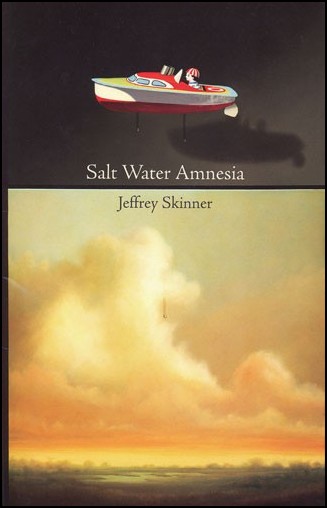
The latest book of poetry by Jeffrey Skinner, a creative writing professor at the University of Louisville, is a contemporary work, if only because an entire prose poem is centered around David Letterman. In its predominance of prose poetry, “Salt Water Amnesia,” released in September 2005, is also a departure from Skinner’s first four books.
“There’s more humor in it,” Skinner said, laughing upon reference to the Letterman poem. “There’s more oddness, there’s more approaches to poems – they come from all over the place.”
Skinner employs the conversational tone that has become a staple of contemporary poets, pairing it with a diction that at times is scientifically precise. The prose poem “The Experiment” begins: “I sewed my father into a specially designed, handmade bear suit. He was indistinguishable from a real bear, and yet retained the necessary functions of a human.”
The book is composed of three parts, with ocean imagery recurring as regularly as the tide throughout. But each part has an emphasis. In the first the ocean is ever-present, compared to even the most unlikely subjects. The third section deals with more personal topics, but the second, entitled “Theories and Inventions,” is almost a book of its own. Inventions include “Invention to Walk on Water” and “Invention for Contemporary Packaging.” In his theories the poet struggles to identify, rather than explain away, insomnia, a wounded hen, last moments.
It’s important that each of his books has unifying elements, Skinner said; he does not just make collections. And he is very careful about which poems he finally selects for publication.
Long before he publishes he makes sure that 10 to 20 of the poems have already been printed in magazines. “I want them to be tested against the world.”
Skinner wrote most of “Salt Water Amnesia” in 2003 when he visited Connecticut, and the ocean, after a long absence. “I spent 25 years in Connecticut, mostly on coastal towns, so I always had the ocean,” he said. “I grew up with the ocean, and the only thing I missed when I moved here was that big body of water. … In Connecticut, it was like going back to my childhood, going back to my beginnings.”
Ironically, however, poetry played little part in Skinner’s childhood. In fact, he was pursuing a master’s degree in psychology at the University of Bridgeport when poetry threw his career path into a topspin.
“I started writing when I was about 22,” Skinner said. “It was after college. I’d been in theater in college, and I had the feeling I was some sort of artist but I didn’t know what my art was. And I happened upon a book of poems by W.S. Merwin … and I was transformed. I didn’t know you could do that with language.”
Six years later, Skinner earned his MFA in writing at Columbia University. “Late Stars,” his first book of poems, was released in 1985; National Poetry Series award winner “A Guide to Forgetting” followed in 1988. He was hired at U of L soon afterward as the university’s first resident writer.
“I was hired basically as a poet,” Skinner said. But he wasn’t the only person to apply for the job. “Everything done in poetry and fiction is extraordinarily competitive. It’s about as bad as professional sports.”
The competitiveness of the business is why all five of Skinner’s books have been with different publishers. “It is hard to get a loyalty with a particular publisher. … It happened three times, I think, that the person in charge who loved my work left as soon as they published me, and with other people in charge, it’s usual to do a cleaning of house.”
Skinner picks his publishers based on reputation and distribution. For “Salt Water Amnesia,” he chose Ausable Press for its association with Consortium Distributors.
“If I just wanted to make money there’s lots of things that’d be more pleasant than writing poetry. Writing poetry’s hard,” he said. Royalty money hardly factors into deciding on a publisher. “There’s not a lot of money in poetry no matter how you slice and dice it. There’s only one poet in America who can live on what he makes from poetry … and that’s Billy Collins.” Collins was U.S. Poet Laureate from 2001-2003.
As for prose poetry, Skinner is eager to return to verse. Prose poetry, he said, was a feature of this book alone.
“I am a poet that changes,” he said. “I’m always looking for ways into that place of poetry and it’s never straight ahead.”